Introduction: The ERP Decision That Defines Your Next 10 Years
In 2026, choosing an ERP is not just an IT decision — it's a business survival decision. Your ERP runs your finance, inventory, HR, sales, manufacturing, and customer data. Get the deployment model wrong, and you pay for it for a decade in ballooning costs, architectural rigidity, and lost organizational agility.
For businesses across India, from tech startups in Bangalore to manufacturing powerhouses in Chennai and growing SMBs in Salem, the biggest question is no longer whether you need an ERP, but which of the ERP deployment options you should choose: Cloud ERP vs On-Premise ERP?
At Hexbee Software Solutions, a leading ERP software company in Bangalore, cloud ERP development company India, and comprehensive Software development company India with strong expertise in Custom ERP development Chennai, we have implemented 60+ ERP systems across both architectures. We have seen companies save crores by migrating to cloud, and we have also worked with regulated sectors where on-premise or hybrid remains essential.
This complete guide breaks down cloud ERP vs on-premise ERP across 12 critical dimensions, real Total Cost of Ownership (TCO) in India, and an actionable decision matrix for 2026.
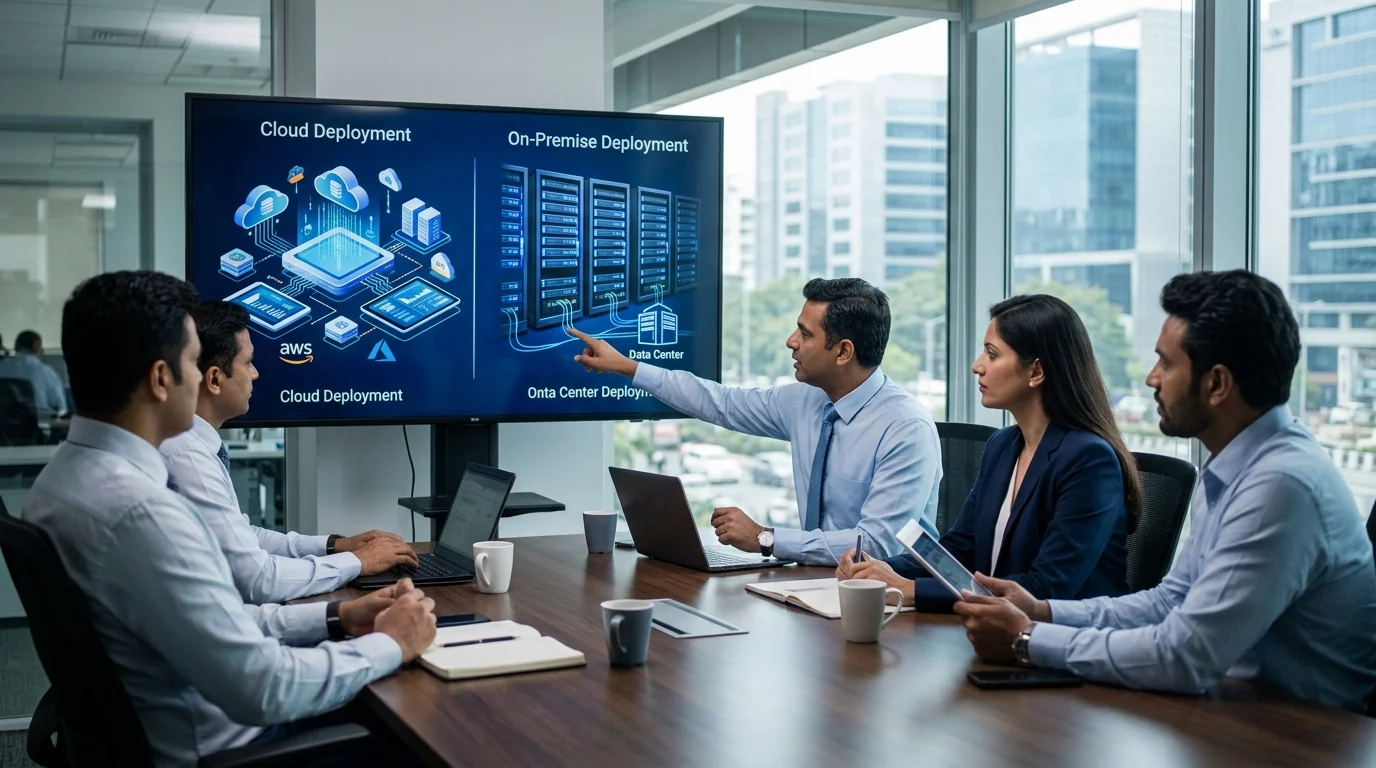
An ERP hosted on secure cloud infrastructure (AWS, Azure, GCP) delivered as a scalable SaaS service. Vendor manages servers, security, and updates.
- • Subscription Model: Predictable per-user OPEX
- • Zero Hardware Setup: Instant provisioning
- • Seamless Scalability: Add users across Bangalore, Chennai & Salem in minutes
- • Built-in AI & Automation: Continuous quarterly upgrades
An ERP installed on physical servers inside your own corporate data center. You own the hardware, data sovereignty, and source code customizability.
- • Perpetual License: High upfront CAPEX investment
- • Full Data Sovereignty: Data never leaves your premises
- • Deep Core Customization: Full source code modifications
- • Offline Shop-Floor Operation: Works without active internet
Cloud ERP vs On-Premise ERP: The 12-Point Detailed Comparison for 2026
1. Cost & TCO: CAPEX vs OPEX in the Indian Market
Cost is the primary evaluation filter for most Indian CFOs and IT heads:
Verdict: For 90% of SMBs and mid-market enterprises, Cloud ERP reduces 5-year TCO by 40%–60%.
2. Security, Compliance & Data Sovereignty
Top cloud providers (AWS, Azure) spend billions on enterprise security that individual private data centers cannot match. Cloud ERP provides ISO 27001, SOC 2 Type II certifications, end-to-end encryption, automated multi-region backups, and RTO under 4 hours.
On-premise offers absolute physical data sovereignty inside Indian premises, which is mandatory for defence, government PSUs, and strictly localized banking workloads. However, the business assumes full liability for firewall patch cycles and ransomware protection.
Hexbee Solution: We offer Private Cloud ERP deployed in AWS Mumbai/Hyderabad with strict data residency within India.
3. Customization & Architectural Flexibility
On-premise allows deep, unrestricted source code modifications, making it ideal for specialized industrial plants with proprietary shop-floor machinery.
Modern Cloud ERP in 2026 uses API-first microservices and low-code extension frameworks. You can customize 80%–90% of business logic, reports, and UI without touching the core codebase, ensuring upgrades never break customizations.
4. Implementation Speed & Time-to-Value
Cloud ERP goes live in 3 to 6 months using pre-configured industry templates for Indian GST, supply chain, and retail. On-premise deployments typically take 9 to 18 months due to server procurement, networking setup, and manual software tuning.
5. Scalability & Multi-Location Access
Opening a new branch in Salem, Chennai, or expanding to tier-2 cities? Cloud ERP scales instantly via browser or mobile app without additional servers or complex VPNs. On-premise requires hardware expansions and dedicated network provisioning for each new location.
6. Automated Upgrades & Continuous Innovation
Cloud ERP receives seamless quarterly feature upgrades, security patches, and tax updates automatically without downtime. On-premise ERP upgrades are costly, high-risk projects that frequently leave companies running 3–4 versions behind.
7. Indian Compliance: GST, E-Invoicing & E-Way Bills
Indian tax regulations evolve rapidly. A cloud ERP built by an Indian ERP software company in Bangalore like Hexbee pushes statutory GST updates, TDS revisions, and NIC e-invoice API changes automatically within days of notification.
8. Third-Party Integration Capabilities
Modern businesses operate on an integrated ecosystem — Shopify, Salesforce, Zoho, Tally, payment gateways, and logistics aggregators. Cloud ERPs with RESTful APIs and webhooks integrate in days, whereas on-premise integrations require legacy middleware.
9. Disaster Recovery & Business Continuity
Cloud ERP features automated cross-region geo-replication. Even if physical office locations in Chennai face seasonal flooding or power outages, business operations continue uninterrupted via cloud nodes.
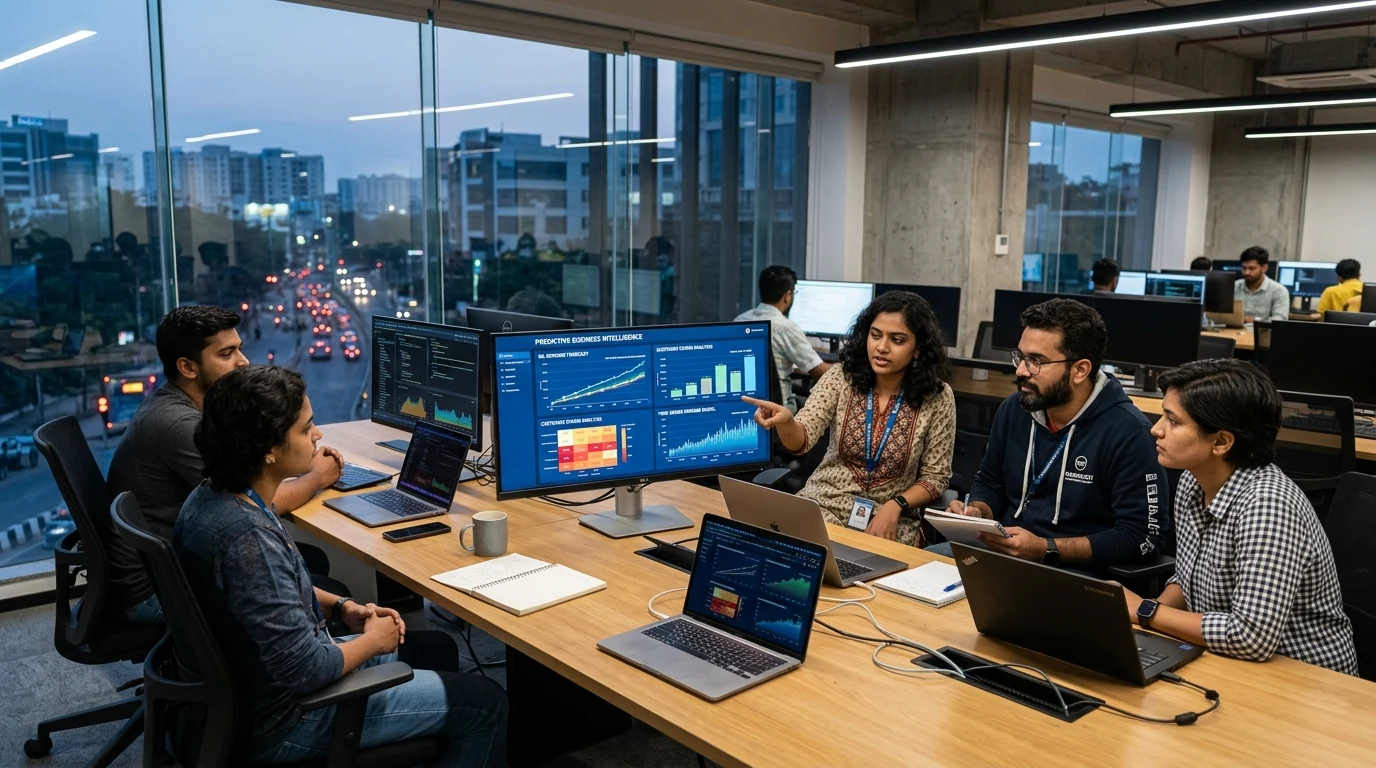
10. Applied AI, Predictive Analytics & Generative BI
In 2026, ERP systems function as intelligent operational hubs. Cloud ERP leverages cloud-native GPUs for demand forecasting, automated PO generation, and conversational BI queries (e.g., "What is our cash flow projection for next month?").
Which ERP Deployment Model Should You Choose? Decision Framework by Hexbee
Choose Cloud ERP If:
- • You have 10 to 500 users (SMB or growing mid-market company).
- • You prefer low upfront capital costs and predictable OPEX.
- • You need rapid time-to-market (go-live in 3–6 months).
- • You have distributed branches across Bangalore, Chennai & Salem.
- • You want hands-free GST, TDS, and regulatory updates.
- • Recommended for: Retail, D2C, SaaS, Services, Distribution, Healthcare SMBs.
Choose On-Premise ERP If:
- • You operate in defence, government PSUs, or highly regulated BFSI.
- • Regulatory compliance strictly forbids data leaving local premises.
- • You require deep source-code modification for heavy manufacturing shop floors.
- • You operate in remote facilities with intermittent internet connectivity.
- • You already maintain a world-class tier-3 corporate data center.
Hybrid ERP: The 2026 Enterprise Trend
Over 70% of enterprise clients in 2026 deploy a Hybrid ERP model:
- Core Financials & HR: Private Cloud or On-Premise for stringent governance.
- Sales, CRM, E-Commerce & Inventory: Public Cloud for high-traffic scalability.
- Shop-Floor Manufacturing (MES): On-premise edge servers for zero-latency offline continuity.
Cost Comparison 2026: Real Numbers for Bangalore / Chennai / Salem
| Scope | Custom Cloud ERP | On-Premise ERP | Timeline |
|---|---|---|---|
| 20 Users (SMB / Startup) | ₹8L–₹15L setup + ₹1.2L–₹2.5L/yr | ₹40L–₹85L setup + ₹8L–₹15L/yr | 3 – 4 months |
| 100 Users (Mid-Market) | ₹20L–₹45L setup + ₹6L–₹15L/yr | ₹90L–₹2 Cr setup + ₹18L–₹35L/yr | 4 – 6 months |
| Enterprise (500+ Users) | Custom Hybrid Architecture | ₹2 Cr – ₹5 Cr+ CAPEX | 6 – 12 months |
Why Hexbee Software Solutions is Your Ideal ERP Engineering Partner
Hexbee Software Solutions (hexbeesoft.com) is a specialized product engineering company offering end-to-end ERP development:
- Deep Multi-City ERP Expertise: Recognized as a leading ERP software company in Bangalore, trusted for Custom ERP development Chennai, and partner as Web development company in Salem.
- Cloud-Native Architecture: True microservices built on AWS/Azure with Kubernetes and AI readiness — not legacy lift-and-shift.
- 100% Tailored Workflows: Custom modules built around your exact manufacturing and supply chain operations.
- Pre-Built Indian Compliance: Out-of-the-box GST, e-invoicing, e-way bills, TDS, and PF/ESI automation.
- Seamless Legacy Migration: Rapidly migrating organizations from Tally, Excel, or outdated ERPs within 90 days.
Frequently Asked Questions
Request a Personalized ERP Deployment Comparison for Your Business
Our enterprise architects will analyze your workflows, user count, and compliance needs to deliver a customized 5-year TCO and deployment roadmap within 48 hours.